
How to Protect Concrete During Wyoming Freeze-Thaw Season
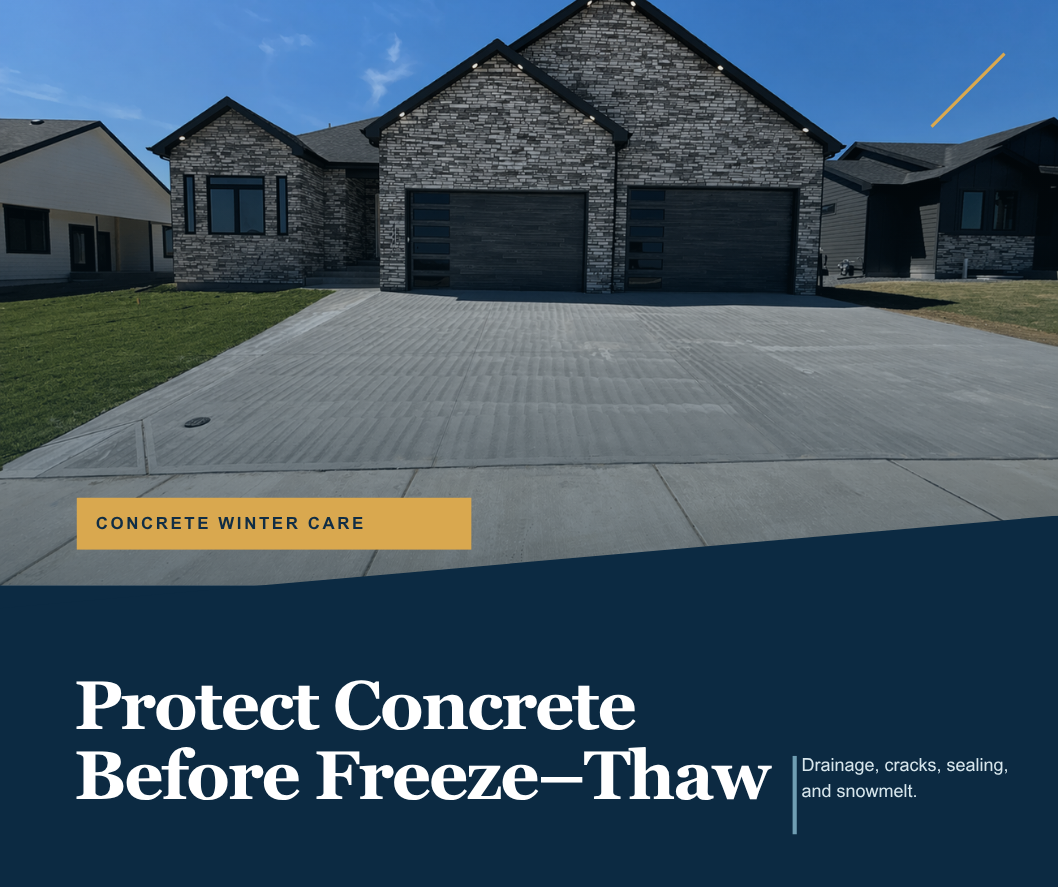
A practical maintenance guide for Casper driveways, patios, steps, and walkways
Wyoming winter can be hard on exterior concrete. Driveways, patios, steps, and walkways repeatedly get wet, freeze, thaw, and get wet again. Those cycles can expose existing cracks, weaken vulnerable surfaces, enlarge settled joints, and create slick areas where water collects.
For homeowners planning concrete maintenance in Casper, WY, the most useful fall work focuses on controlling water and addressing the reason damage developed. A coating or patch can help in the right situation, but it cannot correct an unstable base, poor drainage, ongoing settlement, or concrete that is already deeply deteriorated.
This guide explains what to inspect, what to prioritize before winter, and when a professional evaluation is the better next step. For broader planning, review Skyline’s pre-winter exterior checklist and its guide to concrete driveways and patios in Casper.
Why Freeze-Thaw Damage Starts With Moisture
Concrete contains a network of pores. When concrete becomes highly saturated and the water inside freezes, internal pressure can contribute to scaling, spalling, cracking, and surface loss. Deicing chemicals can intensify that exposure, especially where salty meltwater repeatedly soaks the same joints, edges, and low areas.
The practical goal is not to keep every outdoor surface perfectly dry. It is to reduce unnecessary saturation, preserve drainage, remove snow and ice thoughtfully, and repair openings with materials designed for the actual condition.
1. Walk the Concrete Before the First Hard Freeze
Inspect the surface in dry daylight. Look at the driveway, front walk, porch, steps, patio, garage apron, and any transition between concrete and asphalt, landscaping, or the foundation. Photograph defects so you can compare them later.
Watch for the following conditions:
New, widening, or uneven cracks
Flaking, scaling, pitting, or loose surface material
Sunken slabs or raised edges that create a trip hazard
Open joints, failed joint filler, or vegetation growing through gaps
Standing water after irrigation or precipitation
Downspouts or roof valleys discharging onto concrete
Rust staining or exposed reinforcing material
Small cosmetic wear and structural movement are not the same problem. A stable hairline crack may need a different response than a crack with vertical displacement, recurring movement, or water flowing through it.
2. Fix Drainage Before Applying a Surface Product
Water that repeatedly ponds on a slab or flows toward a garage, step, or foundation is a higher priority than appearance. Clear leaves and debris from joints and drainage paths. Redirect downspouts away from walking surfaces and low spots. Adjust irrigation that sprays concrete or keeps the slab edge continually wet.
Do not create a new problem by piling soil or mulch against siding, door thresholds, or the slab edge. If settlement has reversed the intended slope or a large area holds water, drainage or lifting options may need to be evaluated before sealing.
3. Repair Cracks According to Their Cause and Movement
Crack repair works best when the opening is clean, dry as required, properly prepared, and matched to a compatible repair material. Some cracks are essentially stable; others continue to open, close, settle, or shift. Rigid material placed in a moving joint may separate quickly, while a flexible joint product may be inappropriate for a damaged structural area.
A contractor should determine whether the defect is limited to the surface or related to base failure, drainage, frost movement, overloading, reinforcement corrosion, or settlement. Repair loose and hazardous edges promptly, but avoid covering evidence that helps explain the cause.
4. Decide Whether Sealing Is Appropriate
A penetrating or film-forming sealer may reduce water or chemical exposure on suitable concrete, but no product is universal. Existing coatings, moisture condition, age, surface profile, decorative finish, traction needs, temperature, and cure time all affect product selection.
Before applying any sealer, confirm that the concrete is sound and properly cleaned. Follow the manufacturer’s requirements for surface moisture, air and slab temperature, ventilation, application rate, and weather window. Sealing over trapped moisture, contamination, or active deterioration can lead to poor adhesion or an uneven appearance.
5. Use Snow and Ice Practices That Protect the Surface
Remove snow before repeated traffic packs it into dense ice. Use equipment that will not gouge edges or decorative finishes, and set snowplow blades or skid shoes appropriately for the surface. Avoid striking control joints, steps, and raised transitions.
Deicer selection should consider the concrete’s age, condition, finish, manufacturer guidance, surrounding plants, metal components, pets, and the product label. More chemical is not automatically more effective. Sweep away excess material when conditions allow, and avoid repeatedly pushing salty slush onto the same slab edge or joint.
6. Protect Drainage Routes Throughout Winter
Snow storage affects spring drainage. Do not build large piles where meltwater will run toward the garage, foundation, steps, or a low area in the driveway. Keep trench drains, curb openings, and safe discharge routes accessible. During warm spells, check where meltwater travels before it refreezes overnight.
If water consistently crosses a walking route, the lasting repair may involve grading, drainage, downspout routing, or slab correction rather than relying on deicer every storm.
When to Repair and When to Plan Replacement
A focused repair may be reasonable for a limited crack, isolated spall, open joint, or small drainage correction when the surrounding concrete remains stable. Broader replacement may be more practical when several panels have settled, cracks show significant displacement, the surface is widely delaminated, reinforcement is exposed, or the base and drainage cannot be corrected through a small repair.
Ask for a written scope that identifies demolition limits, base preparation, drainage, slab thickness, reinforcement, joints, concrete exposure requirements, finishing, curing, weather protection, and when the new surface may receive traffic or deicers.
Frequently Asked Questions
Should every concrete crack be filled before winter?
No. The crack should first be evaluated for width, depth, movement, moisture, and cause. A compatible repair may reduce water entry, but filling a moving or contaminated crack without preparation can create a short-lived repair.
Can I seal concrete immediately before freezing weather?
Only when the selected product, surface condition, and forecast meet the manufacturer’s requirements. Many products need a clean, dry surface and a suitable temperature and curing window. Waiting for proper conditions is better than trapping moisture or losing adhesion.
Is rock salt safe for every driveway?
No deicer choice is right for every surface. The concrete’s age and condition, the product chemistry, application rate, surrounding materials, and exposure pattern all matter. Follow the label and the concrete contractor’s maintenance guidance.
What concrete problems should be treated as urgent?
Prioritize unstable steps, trip hazards, loose pieces, exposed steel, rapidly widening cracks, water flowing toward the building, and damage that affects vehicle or pedestrian safety.
Prepare Your Concrete for Winter
The strongest winter maintenance plan combines drainage, timely repairs, careful snow removal, and products selected for the existing concrete. Address the cause first, then protect the surface.
Contact Skyline Construction to discuss concrete repair or maintenance before winter in Casper and Natrona County.
Skyline Construction LLC
259 S Center, Ste 201, Casper, WY 82601
(307) 225-9399