
Should You Replace Windows Before Winter?
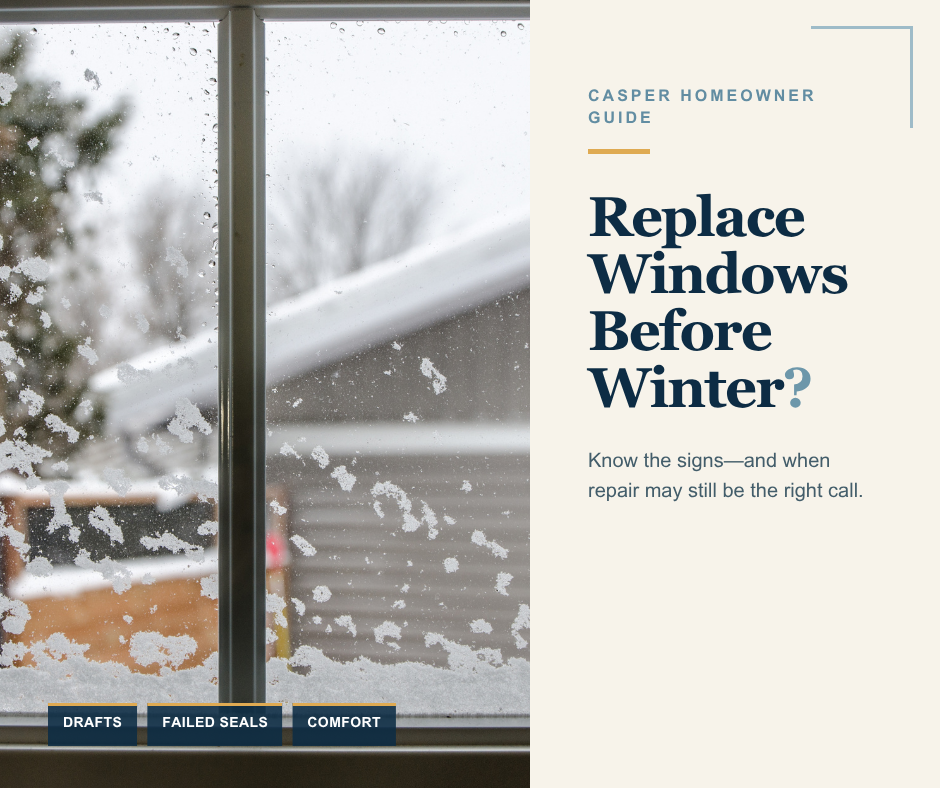
A Casper homeowner’s guide to repair, replacement, and fall installation
Cold weather has a way of making window problems obvious. A room feels drafty, one sash is difficult to lock, condensation appears in the wrong place, or the trim shows staining after wind-driven precipitation. The question is whether the window needs a simple adjustment, a targeted repair, new glass, an insert replacement, or a full-frame replacement.
For homeowners considering window replacement before winter in Casper, the answer should come from the condition of the entire opening—not the calendar alone. The glass, sash, frame, hardware, flashing, perimeter air seal, exterior trim, and adjacent siding or stucco all contribute to performance.
This guide explains the warning signs that deserve attention, the difference between repair and replacement, and what a well-planned fall installation should include.
Start With the Symptom, Then Find the Source
A cold area near a window does not automatically mean the unit is defective. Glass surfaces are cooler than insulated walls, and occupants can feel that temperature difference even without a major leak. Actual drafts can also come from worn weatherstripping, an unlocked sash, an opening behind trim, or a gap between the frame and rough opening.
Likewise, interior condensation can be influenced by indoor humidity, glass temperature, ventilation, and outdoor conditions. Moisture trapped between panes is different: it generally indicates that the insulated-glass seal has failed. Each symptom points to a different repair path.
Skyline’s guide to energy-efficient windows explains why whole-unit performance, frame type, glass, operating style, and installation quality should be considered together.
1. Drafts Continue After Basic Adjustments
First confirm that the window closes completely and the lock pulls the sash into the seal as intended. Clean debris from tracks, inspect accessible weatherstripping, and look for obvious gaps without disassembling the unit. If airflow remains noticeable during wind, the problem may involve worn seals, frame alignment, perimeter insulation, or the rough opening.
Temporary films and removable products may reduce a symptom for a season, but they do not correct concealed gaps, failed flashing, or a distorted frame. Repeated drafts around several windows can also point to a broader installation or air-sealing issue. Skyline’s article on where cold air enters a Casper home can help homeowners compare window symptoms with other exterior leakage paths.
2. Condensation or Fogging Appears Between Panes
Moisture or haze between panes means the insulated glass is no longer sealed as designed. The window may still open and close, but its view and thermal performance can decline. Depending on the product, age, warranty, and condition of the frame, replacement glass or sash may be available.
If the frame is sound and the failure is limited to glass, replacing the entire opening may be unnecessary. If several seals have failed, parts are unavailable, frames are deteriorating, or other problems are present, complete replacement may offer a more practical long-term scope.
3. The Window Is Hard to Open, Close, or Lock
A window that binds or refuses to lock should not be forced. The cause may be dirt or paint buildup, worn balances, damaged hinges, failed hardware, frame movement, swelling, or an opening that is out of square. Operation and locking are important for ventilation, security, cleaning, and emergency use.
One repairable hardware problem is different from repeated failure across the frame. Ask whether parts can be serviced, whether the frame remains stable, and whether the opening can be restored without disturbing surrounding finishes. Bedrooms and other required emergency openings also need to maintain the applicable clear opening and operation.
4. Water Stains, Soft Trim, or Peeling Finishes Return
Staining or deterioration near a window deserves diagnosis before the area is covered. Water can enter at head flashing, sill details, perimeter joints, adjacent cladding, roof-to-wall transitions, or another location above the opening. Interior condensation can also damage finishes, so the path must be confirmed.
Replacing a window without correcting defective flashing or drainage can allow the problem to continue. A full-frame approach may be appropriate when the opening needs to be exposed so damaged materials can be removed and water-management details rebuilt. Do not rely on surface caulk to hide recurring moisture.
5. Frames, Sashes, or Exterior Components Are Deteriorated
Look for rot, corrosion, cracks, warping, loose joints, damaged cladding, failed glazing materials, and trim that no longer holds a sound finish. Localized deterioration may be repairable when the source is corrected and compatible parts are available. Widespread or structural damage can make replacement more reliable.
The surrounding wall matters too. Siding, stucco, trim, flashing, and the weather-resistive barrier must integrate with the new or repaired window. An estimate should explain how those materials will be opened, protected, restored, and finished.
6. Comfort Problems Are Widespread and Recurring
If several rooms remain uncomfortable, compare the windows with insulation, air sealing, heating distribution, solar exposure, and room use. Replacing windows can be part of the solution, but it should not be presented as a cure for every comfort problem.
A focused evaluation may include visual inspection, operation checks, moisture review, and—when useful—blower-door testing or thermal imaging by a qualified professional. The goal is to identify where the building is losing control of air, heat, and moisture before selecting a product.
Repair, Insert Replacement, or Full-Frame Replacement?
Repair is often appropriate for a limited hardware, weatherstripping, sealant, or glass issue when the frame, opening, flashing, and surrounding wall are sound. An insert replacement places a new unit within an existing frame and may reduce disturbance, but it depends on the old frame and opening being suitable.
A full-frame replacement removes the existing unit to expose more of the rough opening. This can be the better path when there is deterioration, past leakage, poor flashing, frame movement, or a need to change the size or configuration. It also creates an opportunity to rebuild the sill, perimeter air seal, insulation, and exterior integration correctly.
The smallest project is not always the least disruptive over time. Ask which parts will remain, which conditions will be visible after removal, and how unexpected damage will be documented and priced.
What Matters When Choosing Replacement Windows
Whole-unit performance ratings appropriate for the home’s climate, orientation, and exposure.
Frame material, durability, maintenance, finish, and availability of replacement parts.
Glass configuration, coatings, spacers, and options suited to glare, fading, and comfort goals.
Operating style, locking hardware, screens, cleaning access, and emergency-opening needs.
Manufacturer installation instructions, anchorage, flashing, drainage, perimeter insulation, and air sealing.
Warranty terms for glass, frame, finish, hardware, labor, and service.
Avoid choosing from a single marketing number. Product selection and installation details should be reviewed as one system, especially for large openings, exposed elevations, and windows integrated with stucco or complex trim.
What to Expect From Fall Window Installation
A contractor should verify measurements, product lead times, access, interior protection, exterior finish work, and the weather plan before removal begins. Openings should be replaced in a controlled sequence so the home is not left exposed. The crew should protect floors and furnishings, contain dust, and explain which rooms need to be clear.
Each new unit should be set square and level, fastened according to the product requirements, integrated with flashing and drainage, insulated at the perimeter, and sealed on the correct interior and exterior planes. Trim, siding, stucco, and paint work should be included or clearly excluded in the scope.
Weather matters. Sealants, flashing products, foams, coatings, and patch materials have temperature and moisture limits. Fall installation can be practical when the project is planned around those requirements rather than rushed into unsuitable conditions.
Questions to Ask Before Approving the Scope
What is causing each symptom, and how was that cause confirmed?
Which windows need repair, glass replacement, insert replacement, or full-frame replacement?
How will the sill, head flashing, weather barrier, insulation, and perimeter air seal be handled?
What interior and exterior trim, siding, stucco, and paint work is included?
How will the home be protected and kept weather-tight during installation?
What happens if concealed moisture damage is discovered after removal?
Who provides warranty service and replacement parts after installation?
Frequently Asked Questions
Does fog between panes mean the whole window must be replaced?
Not always. Some manufacturers or glass companies can replace an insulated-glass unit or sash when the frame is sound. Full replacement may be more practical when parts are unavailable, several components are failing, or the opening has moisture or installation problems.
Can new weatherstripping fix a drafty window?
It can help when the weatherstripping is worn and the sash and frame remain aligned. It will not correct gaps behind trim, missing perimeter insulation, failed flashing, or a distorted frame. The source should be confirmed before selecting the repair.
Will replacement windows solve every cold-room problem?
No. Windows may contribute, but insulation, air leakage elsewhere, heating distribution, room orientation, and indoor humidity can also affect comfort. Evaluate the room and building enclosure as a system.
Is fall too late to replace windows in Casper?
Not necessarily. The schedule depends on product availability, forecast, crew procedures, and the temperature and moisture limits of the installation materials. A clear weather plan is essential.
Plan the Right Window Scope Before Winter
The best window project starts with diagnosis. A repair may solve one isolated problem. A full-frame replacement may be justified when the opening must be rebuilt. Either way, performance depends on the window, flashing, drainage, insulation, air sealing, and surrounding finishes working together.
If your windows are drafty, difficult to operate, fogged between panes, or showing recurring moisture, contact Skyline Construction to evaluate window replacement options for your Casper home.
Skyline Construction LLC
259 S Center, Ste 201, Casper, WY 82601
(307) 225-9399