
Stucco vs. Siding in Wyoming: Durability, Maintenance, and Curb Appeal
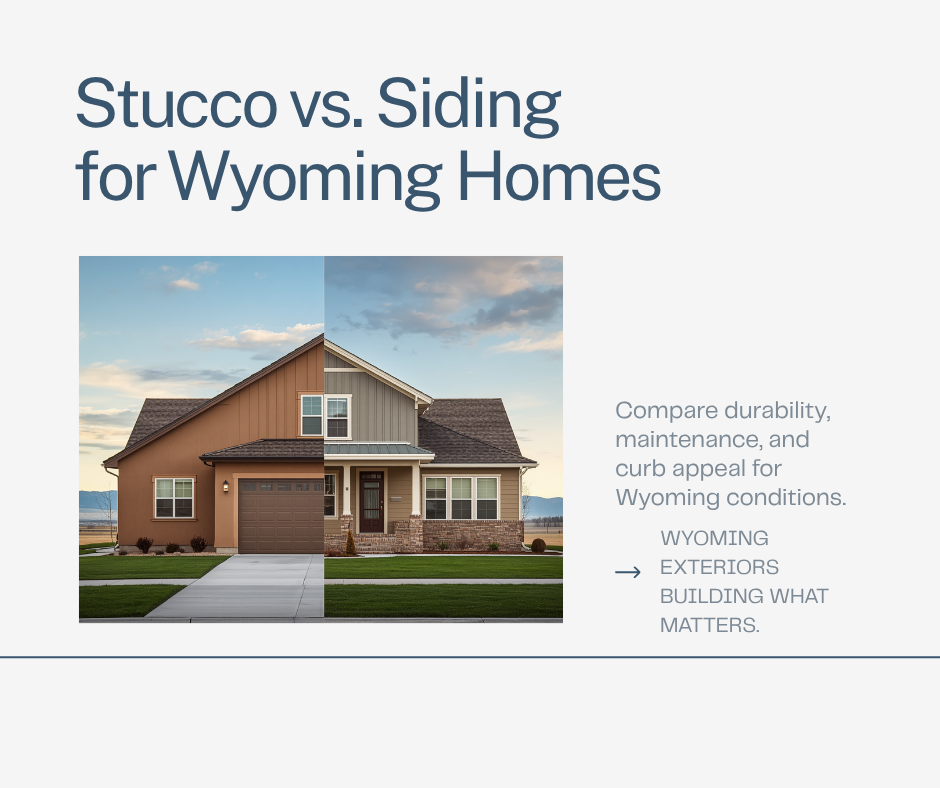
The exterior finish of a home shapes its appearance and helps protect the structure from weather. In Wyoming, that finish must contend with wind, strong sun, moisture, snow, and significant temperature changes. Stucco and siding can both work well, but they differ in construction, maintenance, repair, and architectural character.
There is no universal winner. The right choice depends on the building, site exposure, design goals, maintenance expectations, budget, and quality of installation. Use this comparison to prepare for a more productive conversation with your contractor.
How stucco works
Traditional stucco is a multi-layer exterior system applied over a prepared substrate and weather-resistive assembly. It creates a continuous surface that can suit Southwestern, contemporary, and transitional architecture. Texture and color options allow the finish to range from smooth and restrained to more visibly handcrafted.
EIFS, or exterior insulation and finish systems, can resemble stucco but uses a different layered assembly that may include exterior insulation. Because traditional stucco and EIFS manage water and impacts differently, homeowners should know which system is being proposed and how it will be detailed.
How siding works
Siding is installed in individual boards, panels, or shingles. Common categories include fiber cement, engineered wood, vinyl, metal, and natural wood. Each has different requirements for clearances, fastening, joints, finishing, and maintenance.
Siding can support many architectural styles and makes it possible to combine profiles, directions, colors, and accents. The product should be selected for the building and installed according to the manufacturer’s requirements.
Performance in Wyoming conditions
Wind exposure is a major consideration for either system. Siding must be fastened and detailed correctly to resist movement and uplift. Stucco assemblies need a sound substrate, appropriate reinforcement, well-planned joints, and careful transitions around openings and rooflines.
Temperature changes cause building materials to expand and contract. Proper gaps, joints, flashing, sealants, and attachment methods allow this movement to occur without concentrating stress. Strong UV exposure can also affect coatings, colors, sealants, and some siding products over time.
Moisture management is essential. Neither stucco nor siding should be treated as the only water-control layer. The complete wall assembly—including flashing, weather-resistive barriers, drainage paths, penetrations, windows, doors, and roof-to-wall connections—must be designed and installed to direct water away from the structure.
Maintenance differences
Stucco should be observed for cracks, damaged sealant, staining, and areas where water may be entering at penetrations or transitions. Small issues may be repairable, but matching texture and color can require skill. The finish may also need cleaning or recoating depending on its condition and exposure.
Siding maintenance varies by material. Some products need periodic painting or staining, while others require cleaning and attention to joints, caulk, fasteners, and damaged boards. Individual sections can sometimes be replaced, although matching an older color or profile may be difficult.
Ask for realistic maintenance guidance for the exact system, finish, color, and exposure of your property rather than relying on a universal schedule.
Energy-efficiency considerations
Exterior finishes contribute to the wall assembly, but energy performance depends on more than the visible surface. Insulation levels, air sealing, thermal bridging, window installation, and moisture control all matter.
Some exterior systems can incorporate continuous insulation, which may improve the thermal strategy when properly designed. The best approach should be coordinated with the rest of the building rather than chosen solely because one product is advertised as energy efficient.
Style and curb appeal
Stucco provides a solid, monolithic appearance and can complement clean contemporary forms or homes with warm regional character. Siding offers more visible lines and can be used to emphasize gables, scale, or architectural rhythm.
Many successful exteriors combine materials. Stucco or siding may be paired with stone, wood accents, metal details, or contrasting trim. A limited palette of charcoal, white, gray, natural wood, and stone can create a modern look that still feels appropriate for Wyoming.
Repairability and long-term planning
Consider how easily the system can be evaluated and repaired after impact, moisture intrusion, or future alterations. Adding a window, changing a deck connection, or repairing a damaged area may be simpler with some assemblies than others.
Installation quality is often more important than the category itself. A well-selected material can still fail when flashing, drainage, clearances, joints, or penetrations are poorly executed.
Choose the exterior as a complete system
When comparing stucco and siding, evaluate climate exposure, maintenance, moisture management, design flexibility, repairability, and the contractor’s experience with the proposed assembly. Ask for the exact product information and a clear description of the wall system behind it.
Call (307) 225-9399
email info@skyline307.com
Find us at 1971 E Yellowstone Hwy, Casper, WY 82601
Visit us at skyline307.com